 US,
US,  UK
UK  Canada
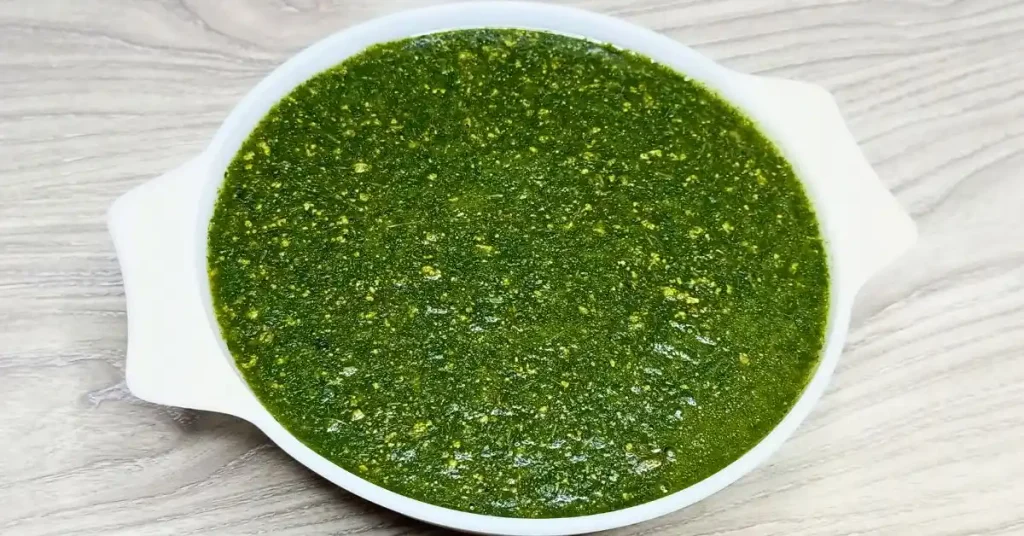
Ewedu is a distinctly Yoruba soup — smooth, vivid green, and slightly slimy in the same family as okra, made from jute leaves cooked down into a soft, almost pourable consistency. If you grew up eating this alongside amala and gbegiri, or you’re curious what it actually is, here’s the full picture.
What Is Ewedu?
Ewedu is a Nigerian soup made from jute leaves (Corchorus olitorius), cooked and blended or pounded until smooth and slightly viscous, similar in texture to okra soup. It’s one of the defining dishes of Yoruba cuisine, most famously served as part of the “amala, gbegiri, ewedu” trio — three dishes eaten together as a single meal, each contributing a different texture and flavor.
Unlike richer, meat-and-oil-forward soups like egusi or banga, ewedu is light, mildly earthy, and deliberately simple in preparation, letting the jute leaf itself be the star rather than a heavy spice blend.
What Does “Ewedu” Mean in English?
Ewedu is the Yoruba name for jute leaf (also called Jew’s mallow or Egyptian spinach in English), the plant this soup is made from. There isn’t a widely used single-word English name that fully captures it — “jute leaf” is the closest direct translation and the term you’re most likely to see on packaging or in an ingredient list outside Nigeria.
How to cook Authentic Nigerian Ewedu Soup Like a Pro
What Is Ewedu Made Of?
Serves 4–6
- 4 cups fresh ewedu (jute) leaves, or 1 packet frozen/dried ewedu leaves
- 2 tbsp ground crayfish
- 1 seasoning cube
- 1/2 tsp locust beans (iru), optional
- Salt to taste
- A small amount of potash (akaun) or baking soda, traditionally used to help soften the leaves and enhance the soup’s characteristic sliminess
- Water, as needed
Ewedu is intentionally kept simple — no palm oil, and far fewer ingredients than most other Nigerian soups. The focus is entirely on getting the texture and seasoning right rather than layering in multiple proteins or spices.
How to Make Ewedu
- Wash and prepare the leaves. If using fresh ewedu, wash thoroughly and remove any tough stems. If using frozen or dried, thaw or rehydrate according to the package.
- Boil the leaves. Place the leaves in a pot with a small amount of water and bring to a boil until fully softened, about 5–10 minutes. The leaves should turn a deeper green and become noticeably tender when pressed against the side of the pot.
- Blend or pound. Traditionally, softened ewedu is blended using a wooden broom whisk called an “ijabe,” rotated rapidly between the palms in a spinning motion to whip the leaves into a smooth, slightly frothy consistency — this technique is as much a skill passed down within families as it is a cooking step, and getting the rhythm right takes practice. A blender or hand mixer works as a modern substitute, pulsed briefly rather than fully liquefied, to preserve some texture without losing the characteristic body of the soup.
- Add the seasoning. Stir in the ground crayfish, seasoning cube, locust beans (if using), and a small pinch of potash or baking soda, along with salt to taste.
- Simmer briefly. Let the mixture simmer for a few more minutes, stirring, until everything is well combined and the soup reaches a smooth, pourable consistency.
- Serve hot, traditionally alongside gbegiri (bean soup) and a swallow like amala.
What Does Ewedu Taste Like?
Ewedu has a mild, slightly bitter, earthy flavor on its own, with a smooth, somewhat slimy texture similar to okra soup — this texture is intentional and expected, not a sign of anything gone wrong. First-time tasters unfamiliar with slimy-textured soups sometimes find it takes a bit of adjustment, the same way okra soup or draw soups like ogbono can surprise someone trying them for the first time. The crayfish and locust beans add a savory depth, but ewedu is generally a lighter, more subtle soup than egusi or banga, which is exactly why it’s traditionally paired with other dishes rather than eaten entirely on its own — its role in the meal is as much about texture and balance as it is about standalone flavor.
What to Eat Ewedu With
Ewedu is almost always served as part of a combination rather than by itself:
- Amala and gbegiri — the classic Yoruba trio. Amala (a dark, smooth swallow made from yam flour) and gbegiri (a bean soup) are traditionally served together with ewedu in the same bowl, each soup poured into its own section.
- Fufu or pounded yam — also work well as a simpler pairing if amala isn’t available.
- Stew — a rich tomato-based stew is sometimes added alongside ewedu and gbegiri to round out the meal with more protein.
Making Ewedu in the Diaspora vs. Back Home
- Fresh ewedu leaves are genuinely hard to find outside major cities, so frozen or dried ewedu is the realistic default for most households in the US, UK, and Canada — and produces a very similar result once cooked down.
- An ijabe whisk isn’t essential. While the traditional rotating whisk technique is part of ewedu’s cultural preparation, a standard blender or hand mixer achieves a comparable texture for home cooking, and most diaspora households use one without any real loss in quality.
- Potash can be skipped if unavailable. It helps enhance sliminess, but omitting it won’t ruin the dish — the leaves will still soften and thicken naturally through cooking and blending.
- Sourcing gbegiri and amala flour alongside ewedu takes some planning. Since the traditional meal is really three dishes served together, it’s worth stocking up on black-eyed peas (for gbegiri) and yam or elubo flour (for amala) on the same grocery trip, rather than treating ewedu as a standalone dish to source separately.
Finding Ewedu Ingredients in the USA, UK, and Canada
Frozen and dried ewedu leaves are stocked at most African grocery stores in cities with a Nigerian community across all three countries, and increasingly available through online African grocery retailers shipping nationwide. (See our full guides on where to buy ewedu in the USA, UK, and Canada.)
Where Does Ewedu Come From?
Ewedu is deeply rooted in Yoruba cuisine, particularly associated with southwestern Nigeria, where jute leaf has been cultivated and cooked for generations. The soup’s pairing with amala and gbegiri is considered a defining combination of Yoruba food culture, commonly served at buka (informal local restaurants) across Lagos, Ibadan, and other Yoruba cities, as well as at home. Jute leaf itself is grown and eaten well beyond Nigeria too — related dishes made from the same plant appear across West Africa, the Middle East, and parts of Asia, though the specific ewedu preparation and its pairing with amala and gbegiri is distinctly Nigerian.
Nutritional Overview
Jute leaf, the base ingredient in ewedu, is genuinely nutrient-dense — it’s a good source of dietary fiber, along with vitamins A and C, iron, and calcium, making ewedu one of the more nutritionally strong soups on this site relative to its simplicity. Because the recipe skips palm oil entirely, it’s also naturally lower in fat than richer soups like egusi or banga, which is worth knowing if you’re looking for a lighter option within Nigerian cuisine without giving up the soup-and-swallow format.