 US,
US,  UK
UK  Canada
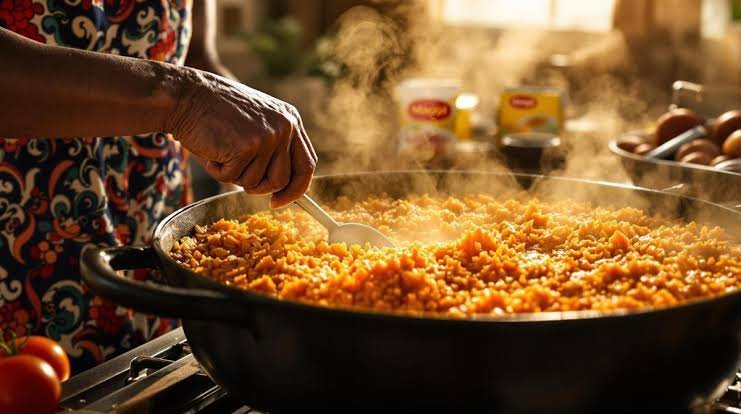
Jollof rice is the dish that starts arguments. Ask anyone from West Africa which country makes it best, and you’ll get a strong opinion delivered with total confidence — usually followed by a story about a specific party where the jollof was unforgettable. This guide covers where the dish actually comes from, why Nigerians, Ghanaians, Senegalese, and Liberians all make it differently, what gives real “party jollof” its smoky depth, and a full recipe you can make wherever you’re living.
What Is Jollof Rice?
Jollof rice is a one-pot West African rice dish, cooked in a base of tomatoes, peppers, onions, and spices, typically alongside chicken, beef, or fish. The rice absorbs the sauce as it cooks, turning a deep red-orange and taking on the full flavor of the base rather than being a plain rice served alongside a separate sauce. It’s the centerpiece dish at almost every West African party, wedding, and celebration — so central to the culture that “party jollof” has become its own specific term for the smoky, deeply flavorful version made in large batches over an open flame.
Where Does Jollof Rice Actually Come From?
Jollof rice traces back to the Senegambia region — modern-day Senegal and Gambia — and the Wolof people, whose name is widely believed to be the origin of the word “jollof” itself (from “Wolof” or the historical Jolof Empire). The dish spread across West Africa through trade routes over centuries, and as it moved into Nigeria, Ghana, Liberia, Sierra Leone, and beyond, each country adapted it with local ingredients and techniques, eventually developing into the distinct regional versions eaten today. So while Nigeria and Ghana argue endlessly about who makes it best, the honest historical answer is that neither of them invented it — Senegal’s ceebu jën (the dish widely considered jollof’s direct ancestor) predates both.
The Jollof Wars: Nigeria vs. Ghana vs. Senegal vs. Liberia
This is genuinely one of the most passionate food debates in West African culture, and it’s worth understanding each version rather than picking a side blindly.
Nigerian jollof rice uses long-grain parboiled rice, a tomato-and-pepper base blended smooth, and is traditionally cooked over an open flame or finished in a way that develops a smoky, slightly charred flavor at the bottom of the pot — the most prized part of the dish for many Nigerians. It tends to be spicier and deeper in color than other versions.
Ghanaian jollof rice typically uses jasmine or basmati rice instead of long-grain parboiled, giving it a more fragrant, slightly different texture. The tomato base often includes more aromatics and sometimes a bit less tomato paste concentration, and many Ghanaian versions incorporate the rice cooking directly with the stock in a way that some say gives it a more uniform, less “wet” texture than the Nigerian version.
Senegalese jollof (ceebu jën) is the dish’s origin point, traditionally made with fish rather than chicken or beef, and often includes vegetables like cabbage, carrots, and cassava cooked directly in the pot alongside the rice and fish — a heartier, more vegetable-forward version than what most people picture when they think “jollof.”
Liberian jollof rice tends to be milder and often incorporates a wider mix of proteins and vegetables in one pot, closer in spirit to a jambalaya-style rice dish than the more streamlined Nigerian or Ghanaian versions.
There’s no universally “correct” answer to which is best — it’s genuinely a matter of what you grew up eating and which flavor profile you prefer. This guide focuses on the Nigerian version, since that’s the most searched and most requested, but the technique translates across all of them.
What Makes Nigerian “Party Jollof” Different From Regular Jollof?
If you’ve heard people specifically crave “party jollof,” this is what they mean: jollof rice cooked in large quantities over an open wood or charcoal fire, which causes some of the rice at the bottom of the pot to lightly char. That smoky, slightly burnt layer — far from being a mistake — is considered the best part of the dish by a huge number of Nigerians, and recreating that smoky depth without an open fire is one of the most searched jollof rice questions there is. We cover exactly how to get this effect in a normal kitchen further down this guide.
Choosing the Right Rice
This matters more than almost any other ingredient decision in the entire recipe. Long-grain parboiled rice is the standard choice for authentic Nigerian jollof, and it’s not a random preference — parboiled rice holds its shape and stays separate as it absorbs the sauce, instead of turning mushy or clumping together the way regular long-grain or short-grain rice can. If your jollof has ever come out sticky, gluey, or mushy, the rice variety is the first thing to check before blaming your technique.
Basmati rice is a common substitute when parboiled isn’t available, and it works reasonably well, though the texture and flavor absorption are noticeably different — closer to what you’d get in a Ghanaian-style jollof than a classic Nigerian one. Jasmine rice is not recommended; its stickiness works against the separate-grain texture jollof rice is meant to have.
How to Make the Perfect Nigerian Party Jollof Rice | Smokey, Rich, and Delicious
Jollof Rice Ingredients
Serves 6–8
- 4 cups long-grain parboiled rice
- 1 can (14 oz) plum tomatoes, or 4–5 fresh tomatoes
- 3–4 red bell peppers
- 2–3 scotch bonnet peppers (adjust to taste)
- 1 large onion, divided
- 1/2 cup tomato paste
- 1/2 cup vegetable oil
- 3–4 cups chicken or beef stock (or water with seasoning cubes)
- 2 bay leaves
- 1 tsp curry powder
- 1 tsp dried thyme
- 2–3 seasoning cubes
- Salt to taste
How to Make Jollof Rice
- Blend the base. Blend the tomatoes, red bell peppers, scotch bonnet peppers, and half the onion together until smooth. This is your pepper-tomato base, often called “ata” or the jollof base sauce.
- Par-cook the base to reduce excess water. Pour the blended mixture into a pot and simmer uncovered for 15–20 minutes, stirring occasionally, until it visibly reduces and thickens. Skipping this step is one of the most common reasons jollof rice turns out watery or undercooked in the middle — the raw blended base carries a lot of water that needs to cook off before the rice goes in.
- Fry the base. In a separate large pot, heat the vegetable oil and fry the remaining chopped onion until fragrant. Add the tomato paste and fry for a few minutes to remove its raw taste, then pour in the reduced tomato-pepper base. Fry the combined mixture for another 10–15 minutes, stirring occasionally, until the oil visibly separates and rises slightly — this is the same “fry it properly” principle that shows up across Nigerian cooking, and it’s just as important here as it is in egusi or efo riro.
- Add stock and seasoning. Pour in the stock, add the bay leaves, curry powder, thyme, seasoning cubes, and salt. Bring to a boil.
- Add the rice. Rinse the parboiled rice, then stir it into the pot. The liquid should sit just above the level of the rice — not drowning it, but enough to fully cook through.
- Cover and cook low. Reduce heat to low, cover tightly (a layer of foil under the lid helps seal in steam if your pot lid doesn’t fit snugly), and let it cook undisturbed for 30–40 minutes. Resist the urge to stir frequently — this is a major cause of mushy jollof rice. Check occasionally and add a small splash of water only if it looks like it’s drying out before the rice is fully tender.
- Rest before serving. Once the rice is tender and the liquid is fully absorbed, turn off the heat and let it sit covered for 10 minutes before fluffing with a fork.
How to Get the Smoky “Party Jollof” Flavor at Home
You don’t need an open fire to get close to this effect. The most reliable home-kitchen method:
- Once the rice is fully cooked and the liquid is absorbed, remove the lid and turn the heat up slightly for the last 2–3 minutes, without stirring, allowing a thin layer at the very bottom of the pot to lightly catch and char.
- Alternatively, some cooks finish the pot briefly over a direct flame (if using a gas stove) after the rice is done, tilting it slightly so one section of the bottom gets direct heat.
- When serving, scrape up a bit of that bottom layer and mix it through the rest of the rice rather than serving it separately — this distributes the smoky flavor through the dish instead of concentrating it in one spot.
This won’t be identical to a giant pot cooked over wood fire at a real Nigerian party, but it gets meaningfully closer than a standard stovetop pot with no finishing step at all.
Common Jollof Rice Mistakes
| Problem | Likely cause | Fix |
|---|---|---|
| Rice is mushy or sticky | Wrong rice type, or too much liquid | Use long-grain parboiled rice specifically; reduce liquid slightly next time |
| Rice is undercooked/hard in the middle | Not enough liquid, or base wasn’t reduced enough before adding rice | Add a small amount of hot water/stock and continue cooking covered on low |
| Jollof tastes flat | Base wasn’t fried long enough, or under-seasoned | Fry the tomato-pepper base longer until oil visibly separates; taste and adjust seasoning before adding rice |
| Rice cooked unevenly (raw on top, mushy at bottom) | Heat too high, or lid not sealing properly | Lower the heat and make sure the pot is tightly covered so steam is trapped evenly |
| Jollof is too oily | Too much oil added upfront | Reduce oil slightly; the fried base should look glossy, not swimming in oil |
Jollof Rice Variations
- Vegan/vegetarian jollof rice — skip the meat and use vegetable stock, adding mushrooms, extra vegetables, or plant-based protein for heartiness.
- Jollof rice and chicken — the most common pairing, with the chicken often marinated and grilled or fried separately, then served on top or alongside.
- Seafood jollof — shrimp, fish, or a mix, closer in spirit to the dish’s Senegalese roots.
- Smoky jollof rice — covered in detail above, the technique-focused version rather than an ingredient variation.
Is Jollof Rice Healthy?
Jollof rice is a carbohydrate-forward dish, and like most one-pot meals, its overall nutritional profile depends heavily on what protein and how much oil goes into it. The tomato-pepper base contributes real nutritional value — tomatoes and peppers are both good sources of vitamins and antioxidants — while the rice provides the bulk of the calories and carbohydrates. Paired with grilled chicken or fish and a side of vegetables, it’s a reasonably balanced meal; made very oily or paired heavily with fried sides, it leans more indulgent. It’s not a “health food” in the diet sense, but it’s not an unreasonable meal either — moderation on the oil is the main lever if you’re watching that specifically.
Is Jollof Rice Spicy?
It has real heat in its traditional Nigerian form, driven by scotch bonnet pepper, but the spice level is entirely adjustable. Reduce the number of scotch bonnet peppers, or remove the seeds before blending, for a milder version without losing the core flavor. Many households make a version for guests or children with little to no heat, and add fresh pepper on the side for anyone who wants it spicier.
Making Jollof Rice in the Diaspora vs. Back Home
- Long-grain parboiled rice is available almost everywhere — look for brands specifically labeled “parboiled” at regular supermarkets in the US, UK, and Canada, not just African grocery stores. This is genuinely one of the easier core ingredients to source correctly.
- Canned plum tomatoes are a reliable substitute for fresh when good, ripe tomatoes aren’t in season where you live, and many diaspora cooks actually prefer canned for consistency.
- Scotch bonnet pepper can be substituted with habanero in a pinch — they’re close botanical relatives with similar heat, though scotch bonnet has a slightly fruitier flavor that’s worth seeking out at an African grocery store if you can.
- Recreating the smoky flavor is the one thing that genuinely takes practice outside Nigeria, since most home kitchens don’t have the open-fire setup that produces it naturally at a real party. The stovetop-finishing technique above gets you close, but don’t expect an exact match on the first try — it’s a skill that improves with repetition, the same way it does for anyone learning it back home.
How to Store and Reheat Jollof Rice
Jollof rice keeps well in the refrigerator for 4–5 days in an airtight container, and it freezes excellently for up to 2–3 months — many people say it tastes even better the next day once the flavors have fully settled. To reheat, add a small splash of water or stock before microwaving or reheating on the stove, since rice dries out as it sits; the added liquid helps restore the original texture.