 US,
US,  UK
UK  Canada
What is puff puff?
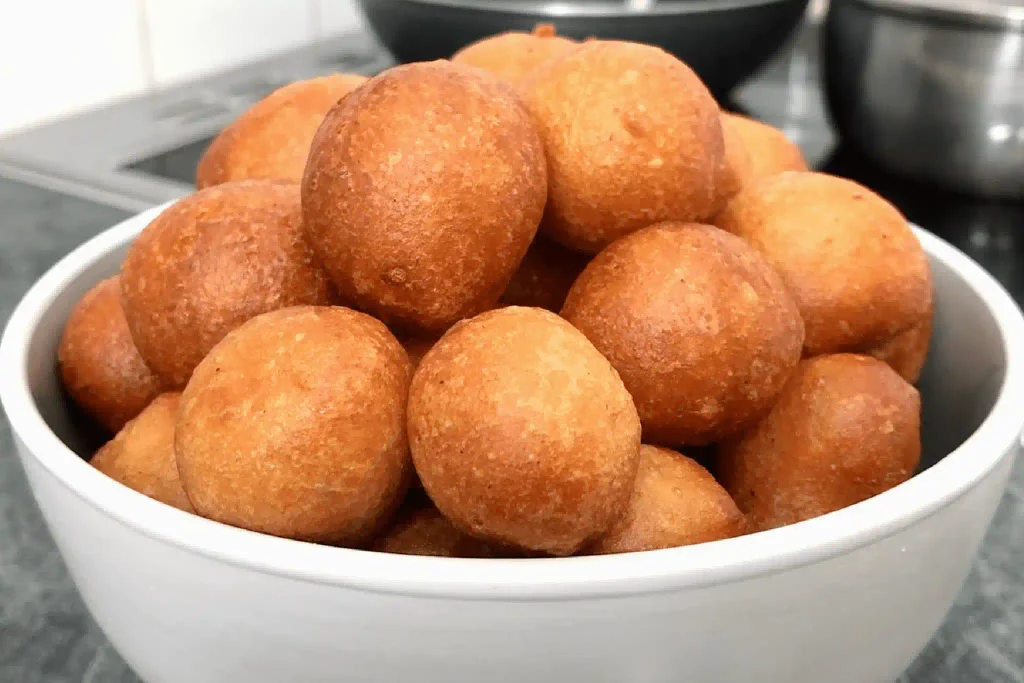
Puff puff is a Nigerian street food and party snack — soft, fluffy, deep-fried dough balls made from a simple yeasted batter of flour, sugar, and water. Golden brown and slightly crisp on the outside, airy and light inside, it’s one of the most beloved Nigerian snacks, sold by street vendors and served at virtually every party, wedding, and gathering. It’s the Nigerian answer to a doughnut hole, though the taste, texture, and preparation are entirely its own.
HOW TO MAKE PUFF-PUFF – NIGERIAN RECIPE
Puff Puff Ingredients
Makes about 20–25 pieces
- 3 cups all-purpose flour
- 1 packet (about 2¼ tsp) active dry yeast
- 1/2 cup sugar
- 1/2 tsp salt
- 1/4 tsp nutmeg, optional
- 1½ cups warm water (not hot — around body temperature)
- Vegetable oil, for deep frying
A note on ratios: if you’re scaling up for a larger batch, the standard rule of thumb is roughly 3 cups of flour to every 1 packet of yeast and 1½ cups of water — so for a 500g bag of flour, use about 1½ packets of yeast and roughly 2 cups of water, adjusting slightly based on how thick your batter looks. For a full 1kg bag, simply double the original recipe.
How to Make Puff Puff
- Activate the yeast. In a small bowl, combine the warm water with a pinch of the sugar and the yeast. Let it sit for about 5–10 minutes until it becomes foamy — this confirms your yeast is active and will help the batter rise properly.
- Mix the dry ingredients. In a large bowl, whisk together the flour, remaining sugar, salt, and nutmeg (if using).
- Combine wet and dry. Pour the activated yeast mixture into the dry ingredients and stir well, either with a wooden spoon or your hand, until you get a smooth, thick, stretchy batter — it should be thicker than pancake batter but pourable, closer to a very thick cake batter.
- Let it rise. Cover the bowl with a clean towel or plastic wrap and let it sit in a warm spot for 45 minutes to 1 hour, until the batter has visibly doubled in size and looks bubbly on top.
- Heat the oil. Pour enough vegetable oil into a deep pot to allow the puff puff to float freely while frying — at least 2–3 inches deep. Heat over medium heat until hot but not smoking.
- Shape and fry. Wet your hand or a spoon with a little water or oil (this stops the sticky batter from clinging to you), scoop a small amount of batter, and drop it directly into the hot oil. Fry in small batches, turning occasionally, until golden brown on all sides — about 3–5 minutes per batch.
- Drain and serve. Remove with a slotted spoon and drain on paper towels. Serve warm, either plain or rolled in a little extra sugar.
What Does Puff Puff Taste Like?
Puff puff has a mildly sweet flavor with a subtle warmth from the nutmeg, wrapped in a crisp, golden fried exterior that gives way to a soft, airy, slightly chewy interior. The yeast gives it a faint, bread-like depth that separates it from a plain fried dough — it’s not overly sweet on its own, which is part of why it pairs so well with a light dusting of sugar or a drizzle of honey.
Tips for Perfect Puff Puff
- Don’t skip the resting time. The rise is what gives puff puff its signature light, airy texture. Rushing this step results in dense, heavy balls instead of the fluffy version you’re going for.
- Get your oil temperature right. Oil that’s too hot browns the outside before the inside cooks through, leaving a raw center. Oil that’s too cool makes the puff puff absorb excess grease and turn heavy. Medium heat, tested with a small drop of batter first, is the safest approach.
- Keep the batter thick, not runny. A batter that’s too thin will spread out flat in the oil instead of holding its round shape. If your batter looks loose, add a small amount of extra flour before frying.
- Fry in small batches. Crowding the pot drops the oil temperature and leads to uneven cooking and greasier results.
Common Puff Puff Variations
- Puff puff with milk and egg — some recipes swap some of the water for milk and add an egg to the batter, producing a slightly richer, more tender result, closer to a doughnut.
- Spiced puff puff — a touch of cinnamon alongside or instead of nutmeg for a warmer flavor profile.
- No-yeast puff puff — using baking powder instead of yeast for a faster version that skips the rising time, though the texture and flavor are noticeably different from the traditional yeasted version.
- Stuffed puff puff — less traditional, but some modern variations fill the dough with a small piece of chocolate or fruit before frying, for a dessert-forward twist.
Nutritional Overview
As a deep-fried, sugar-based dough, puff puff is very much a treat rather than an everyday health food, and it’s worth thinking of it that way rather than trying to make it into something it isn’t. A typical serving provides:
- A meaningful amount of carbohydrates and calories from the flour, sugar, and frying oil
- Some protein from the flour and, in variations that include egg, a bit more
- Little in the way of fiber, vitamins, or minerals, since it’s a refined-flour recipe rather than a whole-grain one
For a slightly lighter version, some households reduce the sugar in the batter itself and instead roll the finished puff puff lightly in sugar or drizzle with honey after frying, giving more control over exactly how sweet each piece ends up.
What to Serve Puff Puff With
Puff puff is typically eaten on its own as a snack, but a few pairings are worth knowing:
- Plain, as a party snack — the most common way it’s served, often alongside other fried snacks like chin chin at gatherings.
- With a hot drink — tea or coffee makes a natural pairing for a puff puff breakfast or afternoon snack, similar to how a doughnut pairs with coffee.
- Dusted with sugar or cinnamon sugar — a simple finishing touch that adds extra sweetness right before serving, especially popular with kids.
- Alongside pepper soup — an unexpected but genuinely popular pairing in some households, where the sweetness of the puff puff contrasts with the heat and richness of a spicy pepper soup.
Where Does Puff Puff Come From?
Puff puff is widely eaten across West Africa, with slightly different names and variations by country and region — it’s closely related to Ghana’s “bofrot” and similar fried dough snacks found throughout the region. In Nigeria, it’s a fixture of street food culture and an essential party food, often prepared in massive batches for weddings, birthdays, and other celebrations where a steady stream of hot, freshly fried puff puff is considered a mark of good hospitality.
Making Puff Puff in the Diaspora vs. Back Home
- Active dry yeast is easy to find everywhere, unlike some other Nigerian pantry staples — it’s stocked at virtually any regular grocery store in the US, UK, and Canada, making puff puff one of the more accessible Nigerian recipes to make consistently abroad.
- Getting the “warm spot” for rising right takes some adjusting. Homes and climates outside Nigeria can run cooler, especially in winter, which slows the rise. A slightly warm (not hot) oven with the door cracked, or resting the covered bowl near a radiator, works well as a substitute for the naturally warm environment many households back home rely on.
- Deep frying at home is a different experience than street-vendor puff puff. Street versions are often fried in large batches over high, consistent heat all day, giving a specific texture that’s hard to fully replicate in a home kitchen — but a well-made batch, following the resting and oil-temperature steps carefully, gets impressively close.