 US,
 UK
 Canada

Shipping to Nigeria from the USA, UK & Canada: The Complete Guide
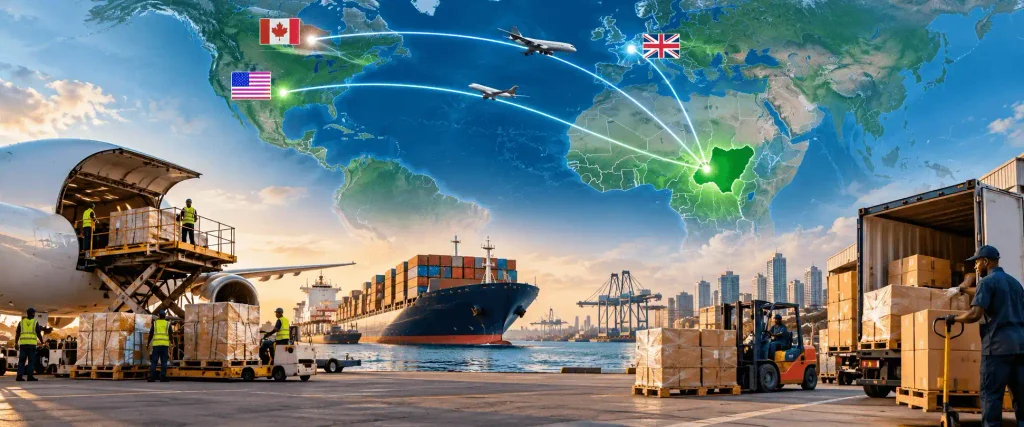
Whether you’re sending a single barrel of household goods back home, shipping a full container for a family relocating, or just trying to get a package to a relative in Lagos before a wedding, the actual process of shipping to Nigeria can feel confusing fast. Between barrel shipping, container shipping, RoRo, air freight, and courier services, it’s not always obvious which option actually fits your situation. This guide breaks down every real option, what it costs, how long it takes, and what you need to know before you commit to a shipping company.
The Main Shipping Methods, at a Glance
Before getting into the details, here’s the quick overview of what exists and when each one makes sense:
Barrel shipping is the go to option for smaller household shipments, filling a plastic barrel with goods and sending it by sea. Slow but affordable.
Container shipping (20ft or 40ft) is for larger volumes, typically used when relocating an entire household or shipping goods in bulk for business purposes.
RoRo (Roll-on, Roll-off) shipping is specifically for vehicles, driving a car directly onto the ship rather than loading it into a container.
Air freight/air cargo is the fastest option by a wide margin, but also the most expensive per pound, generally reserved for urgent or high-value items.
Courier services (DHL, UPS, FedEx) handle smaller packages and documents, fast but priced accordingly, and not practical for anything beyond a modest sized box.
Door to door delivery isn’t a separate shipping method so much as a service level, meaning the shipping company handles pickup at your location and delivery to the recipient’s door in Nigeria, rather than requiring either party to arrange local transport at either end.
Barrel Shipping: The Most Common Choice for Households
Barrel shipping is exactly what it sounds like: you pack your goods into a large plastic barrel (usually 30 to 55 gallon capacity), and it’s shipped by sea along with other barrels in a shared container. This is consistently the most searched, most practical option for people sending household items, food, clothing, or gifts back to Nigeria, and it shows up as real, measured demand across the US, UK, and Canada.
The appeal is straightforward: it’s significantly cheaper than a full container, since you’re sharing space with other people’s barrels rather than paying for an entire container to yourself. The tradeoff is time. Barrel shipments generally take anywhere from 6 to 12 weeks depending on the shipping company, the destination port in Nigeria, and current shipping conditions, so this isn’t the option for anything time sensitive.
Most barrel shipping companies charge either a flat rate per barrel or a rate based on weight, and many offer door to door service where they pick the barrel up from your home and deliver it directly to the recipient in Nigeria, handling customs clearance along the way.
Container Shipping: For Bigger Volumes
If you’re moving significantly more than a barrel or two can hold, whether that’s an entire household relocating or a bulk shipment for business purposes, container shipping is the next step up. Containers typically come in two sizes: a 20ft container and a 40ft container, with the larger option obviously costing more but offering considerably more space.
Container shipping costs vary a lot based on current freight rates, which fluctuate more than people expect, so any quote you get should be treated as a snapshot in time rather than a fixed price. Real searches specifically ask about the cost of shipping a 20ft or 40ft container from the US or UK to Nigeria, which reflects how much this decision comes down to a genuine cost comparison against barrel shipping for people trying to figure out which option fits their actual volume of goods.
A full container makes the most financial sense when you’re shipping enough to fill most or all of the space yourself. If you’re not sure you have enough goods to justify it, a shared or consolidated container (where your goods share space with other shippers, similar in spirit to how barrel shipping works) is worth asking about directly with a shipping company.
RoRo Shipping: Specifically for Vehicles
RoRo stands for Roll-on, Roll-off, and it refers specifically to shipping a vehicle by driving it directly onto the ship rather than loading it into a container. This is generally the more affordable way to ship a car to Nigeria compared to containerizing it, though it does mean the vehicle is exposed to the elements during transit rather than being enclosed, which is a real tradeoff some people prefer to avoid for a higher value vehicle.
RoRo shipping questions show up specifically from the US and Canada in the research, often paired directly with cost questions, since price comparison against container shipping is usually the deciding factor for anyone shipping a vehicle.
Air Freight and Air Cargo: When Speed Matters
Air freight is by far the fastest way to get goods to Nigeria, typically measured in days rather than weeks, but it comes at a real cost premium compared to any sea shipping option. This makes sense mainly for urgent shipments, high value or time sensitive goods, or situations where the cost difference is genuinely worth the speed, such as needing something to arrive before a specific event.
For most household goods and general shipments, sea shipping (whether by barrel or container) remains the more practical and affordable choice, with air freight reserved for the specific situations where waiting weeks simply isn’t an option.
Courier Services: DHL, UPS, and Smaller Packages
For smaller packages, documents, or items that don’t justify barrel or container shipping, standard courier services like DHL and UPS are a real option, and searches specifically asking about DHL and UPS shipping costs to Nigeria show up across all three markets. These services are fast, typically door to door by default, and priced per package rather than by shared space, which makes them convenient but genuinely expensive for anything beyond a modest sized box.
Shipping from the USA to Nigeria
The US shows the strongest shipping demand of the three markets, with real, specific search volume from Houston, Dallas, Chicago, and Atlanta, all cities with significant Nigerian communities. Houston in particular stands out with the highest city-specific shipping search volume in the entire dataset, which tracks with what we’ve noted elsewhere on this site about Houston being one of the largest Nigerian population centers in the country.
Typical questions from US-based shippers center on cost (how much shipping actually costs from the US to Nigeria), timing (how many days or weeks a shipment takes), and documentation requirements for shipping labels, which reflects that most people researching this are doing it for the first time and want a clear, practical answer rather than vague reassurance.
Shipping from the UK to Nigeria
The UK shows particularly strong demand around sea shipping specifically, along with door to door service and finding the best shipping company for the route, suggesting UK based shippers are more actively comparison shopping between providers than simply looking for the cheapest general option. London appears as a specific city in the data, unsurprising given its concentration of Nigerian and West African communities.
A notably UK specific pattern in the research is how often “door to door” appears paired with UK searches specifically, more than in the US or Canada data, suggesting UK shippers place a particularly high value on full service convenience rather than handling pickup or local delivery themselves.
Shipping from Canada to Nigeria
Canada shows the smallest shipping search volume of the three markets, which likely reflects Canada’s smaller overall Nigerian diaspora population compared to the US and UK, something we’ve noted elsewhere on this site regarding grocery store demand too. Montreal shows up specifically in the Canadian data alongside general RoRo and container shipping questions, and DHL courier shipping shows meaningfully higher demand in Canada relative to its other shipping search volume than in either the US or UK, possibly reflecting a preference for smaller, faster shipments over bulk barrel or container options among Canadian based shippers.
What Documents You’ll Need
Shipping goods internationally, especially in bulk, requires proper documentation to avoid delays at customs. If you’re shipping food products specifically, whether for personal use in larger quantities or for resale, our Suppliers page covers the full list of documents typically required for smooth customs clearance, including commercial invoices, packing lists, certificates of origin, and more. It’s worth reviewing that list even for a personal barrel shipment, since some of the same documentation principles apply, particularly around accurately declaring contents.
How to Choose a Shipping Company
A few practical things worth checking before committing to any shipping company:
Ask about door to door versus port to port service. Door to door means the company handles pickup at your location and delivery to the recipient’s door in Nigeria. Port to port means you’re responsible for getting goods to the departure port, and your recipient is responsible for clearing customs and arranging pickup at the arrival port. The price difference reflects that gap in service, and it’s worth knowing exactly what you’re paying for.
Get a real timeline, not a vague estimate. Sea shipping timelines genuinely vary by company, route, and current port conditions, so a company that gives you a specific, confident window (rather than “it depends”) is generally more trustworthy.
Confirm what happens if something goes wrong. Ask directly about insurance coverage, what happens if goods are damaged or lost, and whether tracking is provided throughout the journey, since sea shipping in particular can take long enough that not knowing where your shipment is becomes genuinely stressful.
Compare barrel versus container versus consolidated options for your specific volume of goods, since the right choice really does depend on how much you’re shipping, not just on price per unit.
Read reviews from people who’ve actually used the route you’re shipping on, not just general reviews of the company. A shipping company might be excellent on a Lagos route and inconsistent on a Port Harcourt route, so specificity matters more than an overall star rating.
Ask what happens at customs clearance in Nigeria specifically. Some companies handle this entirely on your behalf as part of a door to door service, while others expect the recipient to be present or to handle paperwork locally. This is one of the most common sources of frustration and delay, so getting a clear answer upfront saves real stress later.
What You Can and Can’t Ship
Most household goods, clothing, non-perishable food, and personal items ship without issue, but a few categories are worth knowing about before you pack a barrel or container. Restricted or prohibited items generally include firearms and weapons, certain electronics depending on current regulations, large amounts of cash, and specific food items that may be restricted for agricultural or health reasons. Rules do shift over time and vary somewhat by shipping company and current customs policy, so it’s worth confirming directly with your chosen shipping company rather than assuming based on a previous shipment or something you heard secondhand.
Perishable food is a genuine gray area. Shelf stable items like garri, dried beans, or packaged snacks generally ship without much difficulty, while fresh produce, meat, or anything requiring refrigeration is far more complicated to ship internationally and often isn’t practical through standard barrel or container shipping at all.
If you’re shipping valuable or sentimental items, declare them accurately on your shipping documentation rather than under declaring value to save on fees. This matters both for insurance purposes if something is lost or damaged, and because customs discrepancies between declared and actual contents are one of the more common causes of shipment delays and, in some cases, penalties.